

Artificial intelligence is transforming publishing far beyond business models or production workflows. It is redefining the infrastructure behind content identification, rights management, and the long-term value of creative works.
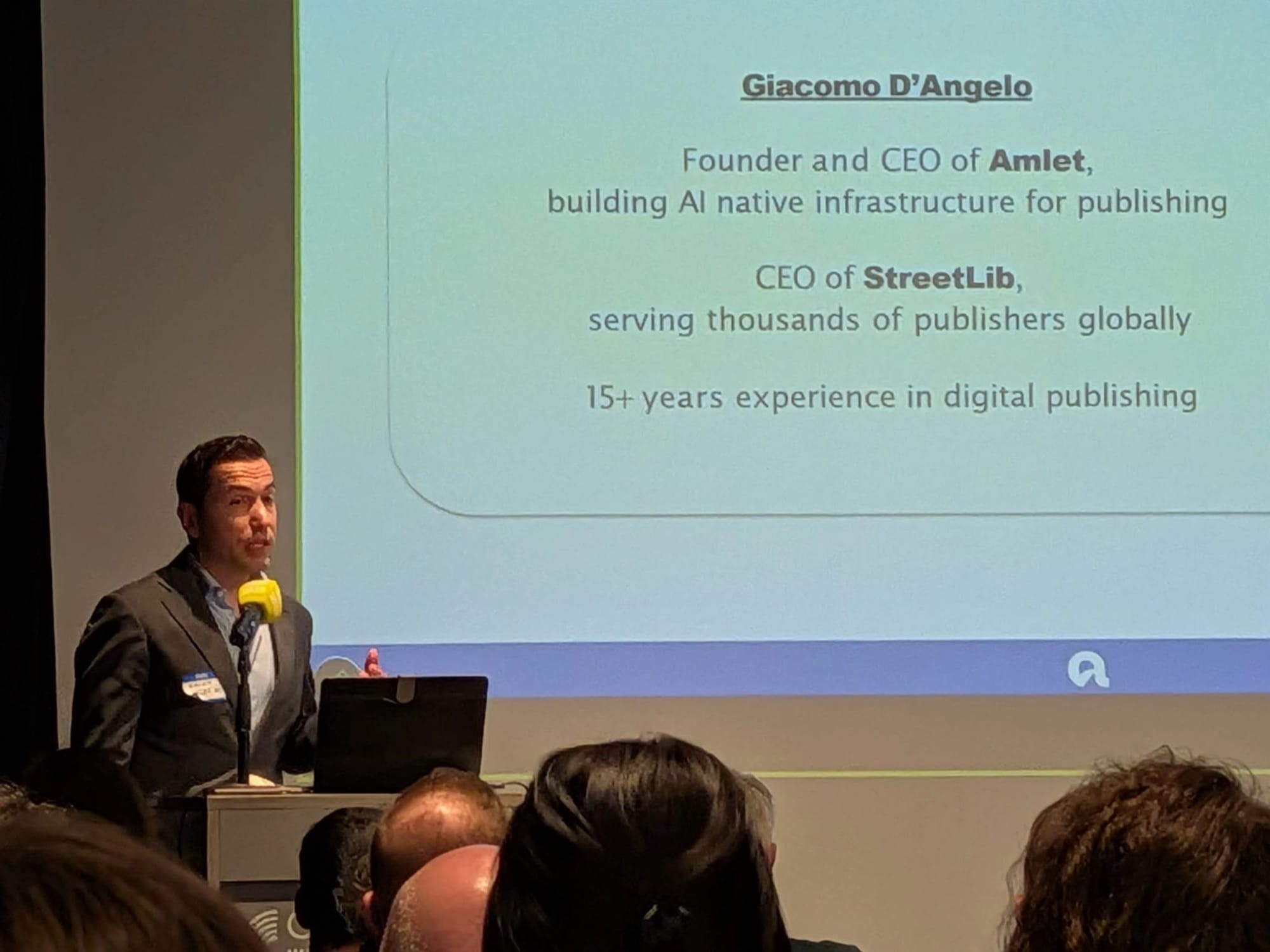
This was the focus of a session led by Giacomo D’Angelo, CEO of StreetLib and Founder and CEO of Amlet, at Doing Rights Right 2026, the international event organized by the Book Industry Study Group (BISG).
Held on January 23 at the Goethe-Institut in New York City, the event explored best practices in publishing rights and licensing. It brought together publishing executives, rights and legal managers, literary agents, and professionals focused on protecting and monetizing publishing catalogs.
Machines are now our readers
During the session, Giacomo D’Angelo raised a simple but crucial point: today, a growing share of written content is no longer consumed directly by readers, but processed by automated systems.
Search engines, recommendation platforms, and artificial intelligence models continuously analyze books and texts for training, information retrieval, and answer generation.
This new form of consumption doesn’t replace human reading. Instead, it exists alongside it, creating an entirely new and structural source of demand.
The challenge is that the publishing industry’s digital infrastructure—along with contracts and copyright protection systems—was designed for a world in which content was meant exclusively for people.
That world has now fundamentally changed.
Rights designed for readers, not AI
Copyright laws, identification standards, and licensing models were created in a context where content use meant reading, selling copies, or traditional licensing.
Artificial intelligence systems, however, operate on an industrial scale. They continuously and automatically process massive volumes of text—far faster than contracts and enforcement mechanisms can keep up with.
According to Giacomo, this gap represents one of publishing’s biggest challenges—and opportunities—for the future: building an infrastructure that makes content identifiable, traceable, and monetizable within the AI economy.
From content identification to digital rights management
At BISG, Giacomo explained how technological advances require moving beyond current systems based solely on product identifiers like ISBNs.
In the AI ecosystem, content needs to be recognized at a much more granular level—directly from the text itself.
This is where the International Standard Content Code (ISCC) comes in. ISCC generates digital fingerprints of content, enabling interoperable identification across platforms, media, and markets.
Building on this foundation, it becomes possible to clearly and automatically declare usage rights for AI, making them accessible to technology platforms in a machine-readable format.
This step is key to promoting transparency, regulatory compliance, and new models of remuneration.
New opportunities in the AI economy
Another key topic in Giacomo’s session was the monetization potential of AI systems’ use of content.
With the right infrastructure, this new demand can become an additional revenue stream for publishers and authors, complementing traditional sales and licensing channels.
The goal isn’t to replace existing models but to create new, scalable ones that align with today’s technological reality.
The shared vision of StreetLib and Amlet
Giacomo’s remarks at Doing Rights Right 2026 reflect a broader mission that StreetLib has pursued for years: developing digital infrastructure for global publishing.
This same vision led to Amlet, a platform dedicated to registering, managing, and licensing digital content for the AI economy, with which StreetLib recently formed a strategic partnership.
The goal is to provide authors and publishers with practical tools to:
- protect their works within the AI ecosystem
- track content usage
- monetize their work while complying with European digital rights regulations
A future where technology and creativity grow together
As discussed with industry professionals at BISG, the future of publishing is not about AI versus human creativity. It’s about building infrastructures that allow both to evolve sustainably.
AI models driven by quality content and respectful of creators’ rights can become an ally for spreading knowledge and unlocking new economic opportunities.
StreetLib continues to invest in this vision, bringing the international expertise of its CEO to the venues where the future publishing landscape is being shaped.
If you want to dive deeper into these topics and learn more about the evolving relationship between publishing and AI, check out our interview with Giacomo D’Angelo, where he shares the story behind Amlet and the vision for the first public registry for Text & Data Mining.